The education boards officially published the SSC Routine 2026 on January 15, 2026. If you are an SSC 2026 candidate, this is the most important document you need right now. It covers all nine general education boards in Bangladesh, and over 20 lakh students will sit for the SSC and equivalent exams this year.
The SSC and equivalent exams will be start from April 21, 2026 and continue until May 20, 2026.The exam has been rescheduled to April–May instead of the traditional February timeline. General elections, the timing of Ramadan, and extended Eid holidays pushed education authorities to restructure the academic year. SSC is the gateway exam at the end of secondary education in Bangladesh. It decides your college admission route, scholarship eligibility, and path forward in academics.
SSC Examination 2026
SSC stands for Secondary School Certificate. It is the public examination taken at the end of Class 10 in Bangladesh. If you pass, you can move forward to colleges, technical institutes, and vocational programs across the country.
Traditionally, Bangladesh has held SSC exams every February — that has been the pattern for decades. Since the COVID-19 pandemic, the system has broken that pattern. The April–May timeline became necessary because of schedule conflicts around national elections, Ramadan, and Eid holidays.
Key Facts to Remember
- SSC Routine release date: January 15, 2026
- Exam start date: April 21, 2026
- Exam end date (theoretical): May 20, 2026
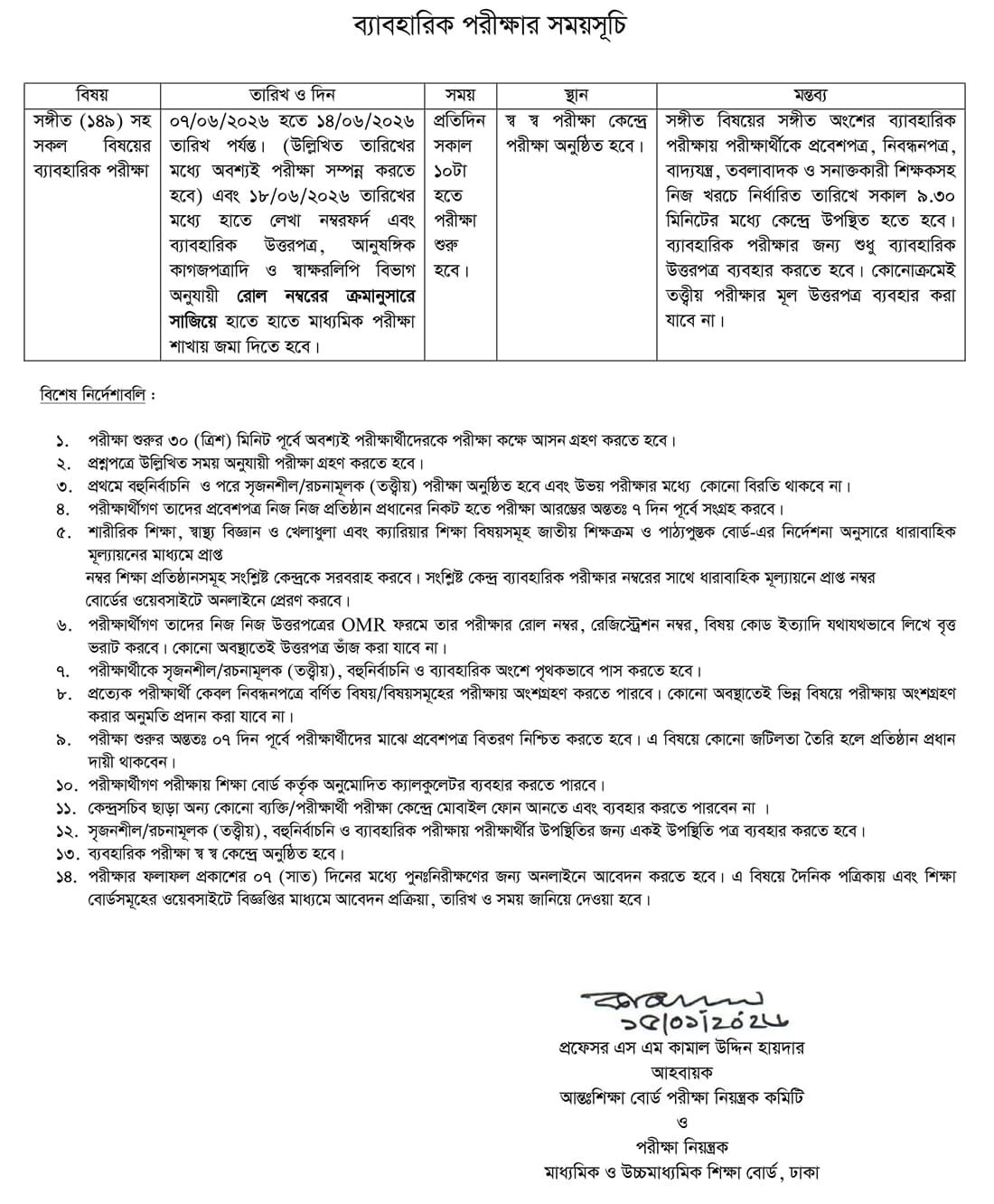
- Practical exam period: June 7–14, 2026
- Total expected candidates: Over 20 lakh
- Boards involved: 9 general + Madrasah + Technical = 11 boards
- Result expected: Late June 2026 (exact date to be announced)
For SSC 2026 Exam, Regular students will follow the revised short syllabus while Irregular and improvement students will follow the full 2025 syllabus.
SSC Routine 2026
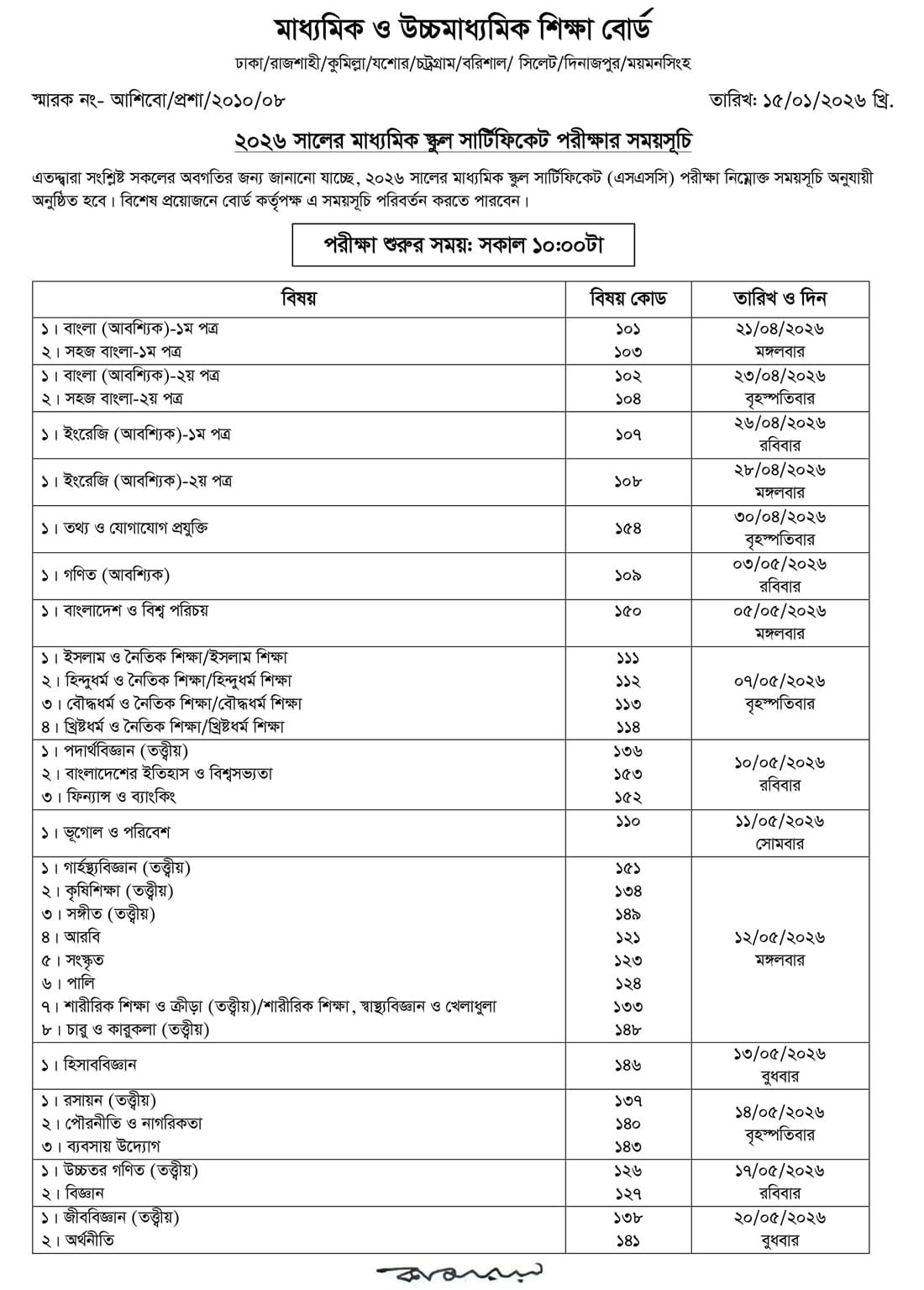
The SSC Routine 2026 is the official examination schedule published by Bangladesh’s education boards. It tells you the exact date, subject, and time for every paper. The Inter-Board Coordination Committee published this schedule on January 15, 2026, giving students three full months to prepare before the first exam. The written theoretical examination begins April 21, 2026, and concludes on May 20, 2026.
The routine is fixed after publication but can change in truly exceptional circumstances. If that happens, the board will issue official announcements through newspapers and board websites.
Why you must follow the routine carefully:
How to download the official SSC Routine PDF
You should always collect the SSC Routine 2026 PDF from your own education board’s official website. Many fake or outdated images spread online every year, and students get confused by old or edited schedules. Avoid saving any routine image shared on social media without verifying the source first.
You can also download the official PDF directly from the button below.
- Go to your education board’s official website
- Open the SSC Corner or Notices section
- Find the SSC Routine 2026 PDF link
- Download it and save it offline
- Print one copy and pin it near your study table
Official SSC Exam Routine 2026
If you are from Dhaka, Chattogram, Rajshahi, Jashore, Cumilla, Sylhet, Barishal, Dinajpur, or Mymensingh Board, your routine is the unified schedule below. If you are a Dakhil or Technical/Vocational candidate, check your board’s separate notice — the dates are aligned but the official document comes from your own board.
|
Date & Day |
Subject |
Subject Code |
|---|---|---|
|
21/04/2026 (Tuesday) |
Bangla (Compulsory) – 1st Paper |
101 |
|
23/04/2026 (Thursday) |
Bangla (Compulsory) – 2nd Paper |
102 |
|
26/04/2026 (Sunday) |
English (Compulsory) – 1st Paper |
107 |
|
28/04/2026 (Tuesday) |
English (Compulsory) – 2nd Paper |
108 |
|
30/04/2026 (Thursday) |
Information & Communication Technology (ICT) |
154 |
|
03/05/2026 (Sunday) |
Mathematics (Compulsory) |
109 |
|
05/05/2026 (Tuesday) |
Bangladesh & Global Studies |
150 |
|
07/05/2026 (Thursday) |
Islam & Moral Education / Islam Shikkha |
111 |
|
10/05/2026 (Sunday) |
Physics (Theory) |
136 |
|
11/05/2026 (Monday) |
Geography & Environment |
110 |
|
12/05/2026 (Tuesday) |
Arabic |
121 |
|
13/05/2026 (Wednesday) |
Accounting |
146 |
|
14/05/2026 (Thursday) |
Chemistry (Theory) |
137 |
|
17/05/2026 (Sunday) |
Higher Mathematics (Theory) |
126 |
|
20/05/2026 (Wednesday) |
Biology (Theory) |
138 |
Note: The complete date-wise subject breakdown is also available in the official PDF published by the Dhaka Education Board. Each exam runs from 10:00 AM to 1:00 PM.
Revised Syllabus & Marks Distribution Changes
NCTB introduced a revised short syllabus for SSC 2026 to reduce academic pressure and keep the exam focused on the most essential learning outcomes.
Who follows what:
- Regular students: revised short syllabus
- Irregular students: full 2025 syllabus
- Improvement students: full 2025 syllabus
Marks distribution changes:
- MCQ marks increased in most subjects, moving from 15 marks to 25 marks
- Creative/theoretical marks adjusted accordingly, often reduced to 75 marks
- Total marks per subject remains 100
- The translation portion has been removed from the Bangla 2nd Paper essay section
SSC Exam Instructions
You should read the exam instructions before your first paper. The Board of Intermediate and Secondary Education issued 14 mandatory instructions for all SSC 2026 candidates. Violating these rules can lead to exam cancellation or disqualification.
- Arrive 30 minutes early: Enter the examination room at least half an hour before start time. This isn’t a suggestion—it’s required for attendance verification.
- Follow question paper timing strictly: Examinations must be conducted according to the time specified on each paper. No extensions, no exceptions.
- No breaks between sections: MCQ tests happen first, followed immediately by Creative/Essay-type tests. Zero break time. Use the bathroom before you enter.
- Collect admit cards seven days prior: Your institution’s head must distribute admit cards at least a week before exams begin. Missing an admit card? You’re not sitting for that exam.
- Continuous assessment marks submission: For Physical Education, Health Science and Sports, and Career Education, institutions submit continuous assessment marks online. Students don’t control this—but verify your school completed it.
- Fill OMR forms correctly: Write and properly fill circles for roll number, registration number, and subject code on OMR answer scripts. Never fold the answer script under any circumstances.
- Separate passing requirements: You must pass the Creative/Essay portion, MCQ portion, and practical components independently. Scoring high in one section won’t compensate for failing another.
- Stick to registered subjects: You may only sit for examinations listed on your registration card. Taking exams for other subjects is strictly prohibited.
- Institution responsibility for admit cards: Schools bear full responsibility for distributing admit cards seven days early. If complications arise, the Head of Institution faces consequences.
- Calculator usage: You’re allowed to use education board–approved calculators. Bring your own—don’t rely on borrowing.
- Mobile phone prohibition: Except for the Centre Secretary, no person or candidate can bring or use mobile phones within exam centers. Leave it at home or locked in a bag outside.
- Single attendance sheet: The same attendance document records your presence for Creative, MCQ, and practical exams. Sign it carefully each time.
- Practical exams at your center: Practical examinations happen at your respective examination center. No traveling to different locations.
- Re-scrutiny applications: Submit re-scrutiny requests online within seven days of result publication. Detailed procedures will be announced through newspapers and board websites.
FAQs
Conclusion
You should treat the SSC Routine 2026 as your exam roadmap. The exam starts on April 21, 2026, and ends on May 20, 2026, with practicals running from June 7 to 14. Over 20 lakh candidates across 11 education boards will sit for this exam.
Your next step is simple. Download the official PDF from your board’s website, match your subjects to the dates, and build your revision plan around the exam order. Follow all official instructions and use the correct routine, and you will avoid unnecessary confusion during the exam.